
Google Gemini 4 Argon that beat OpenAI Astra, Anthropic Fable 5.1, and Opus 5.5.
New model by Google: Gemini 4 Argon that beat OpenAI Astra, Anthropic Fable 5.1, and Opus 5.5.
Why TypeSafe AI’s new “System One” model is fast, inexpensive and potentially important - and where its limitations begin.
For the last few years, the default way to add intelligence to software has been surprisingly indirect.
We send information to a large language model, ask it to explain what should happen, receive a paragraph of text, and then try to convert that paragraph back into something the software can safely use.
That approach makes sense when a human wants an answer. It makes much less sense when a program only needs a decision.
Should this support ticket go to billing or engineering? Is this transaction suspicious? Does this document contain personal information? Should an AI agent continue, retry, escalate or stop?
None of those questions requires an essay. They require a constrained answer, a probability and a reliable format.
That is the problem Jev, a new model from TypeSafe AI, is designed to solve.
Released in early access on September 15, 2026, Jev is the first model in what TypeSafe calls the System One category. It does not compete with ChatGPT, Claude or Gemini at writing, conversation or deep reasoning. It gives up text generation entirely and focuses on fast, structured judgments that software can consume directly.
The simplest description is:
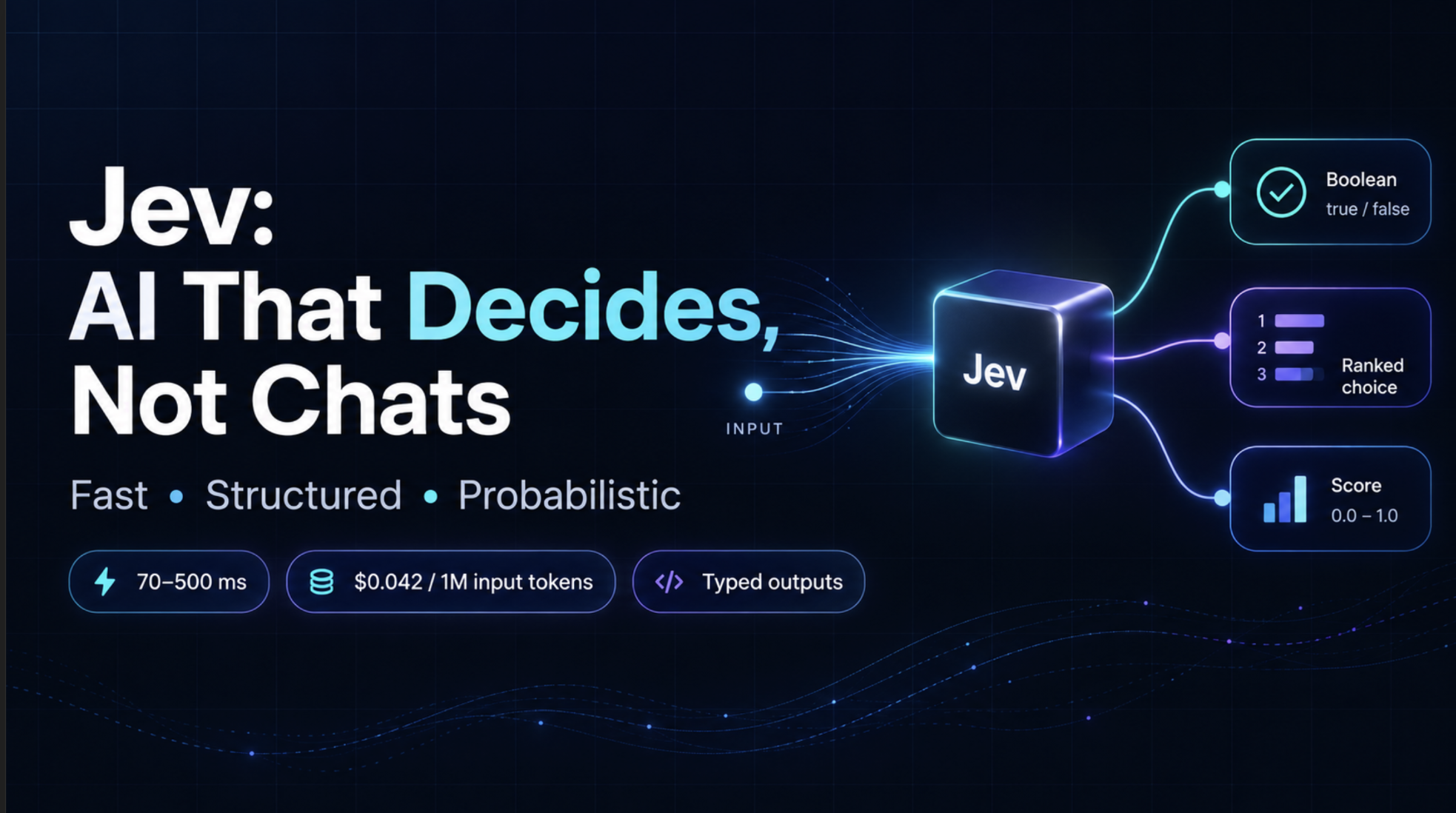
A large language model generates words. Jev chooses, scores and estimates probabilities.
That sounds like a small difference. Architecturally, it changes almost everything.
Jev receives two main things:
State: the information about the current situation, supplied as text or structured data.
Questions: the specific judgments the application wants the model to make.
It then returns typed answers rather than prose. TypeSafe currently exposes three decision primitives:
Primitive | Question it answers | Example |
|---|---|---|
Choice | Which option is most appropriate? | Billing, technical support or sales? |
Score | Where does this fall on a defined scale? | How severe is this incident? |
Noul | How likely is this statement to be true? | Does the message contain a refund request? |
Imagine that a customer sends this message:
“My card was charged twice and I need the duplicate payment returned today.”
Instead of asking an LLM to analyze the message in a paragraph, an application can ask Jev three narrow questions:
{
  "state": "My card was charged twice and I need the duplicate payment returned today.",
  "questions": {
    "department": {
      "type": "choice",
      "options": ["billing", "technical", "sales"]
    },
    "urgency": {
      "type": "score",
      "levels": ["low", "medium", "high"]
    },
    "refund_requested": {
      "type": "noul"
    }
  }
}
Conceptually, the response might say:
{
  "department": {
    "value": "billing",
    "probability": 0.98
  },
  "urgency": {
    "value": "high",
    "probability": 0.91
  },
  "refund_requested": 0.99
}
The exact API schema is slightly different, but the idea is this simple: the model returns values that code can immediately compare, rank and route. There is no paragraph to interpret and no JSON generated token by token and parsed afterward.
According to the official TypeSafe documentation, every question is evaluated independently against the same state. Multiple questions can be processed together in one request.
The name comes from the distinction popularized by psychologist Daniel Kahneman:
System 1 is fast, intuitive recognition.
System 2 is slow, deliberate reasoning.
Jev targets the first category. It is intended for judgments that a knowledgeable person could make quickly when given the right context—not for tasks that require a long chain of reasoning.
For example:
“Which team owns this ticket?” is a System One-shaped question.
“Design the company’s support strategy for the next three years” is not.
“Does this tool call look suspicious?” is a System One-shaped question.
“Investigate the incident, determine its root cause and write the remediation plan” is not.
This distinction is crucial. Jev is useful because it has a deliberately narrow job, not because it can do everything.
The model’s name is a reference to economist William Stanley Jevons and the Jevons paradox: when a resource becomes more efficient and cheaper, total consumption of it can increase rather than decrease. TypeSafe’s thesis is that dramatically cheaper machine intelligence will lead developers to put far more decisions inside software.

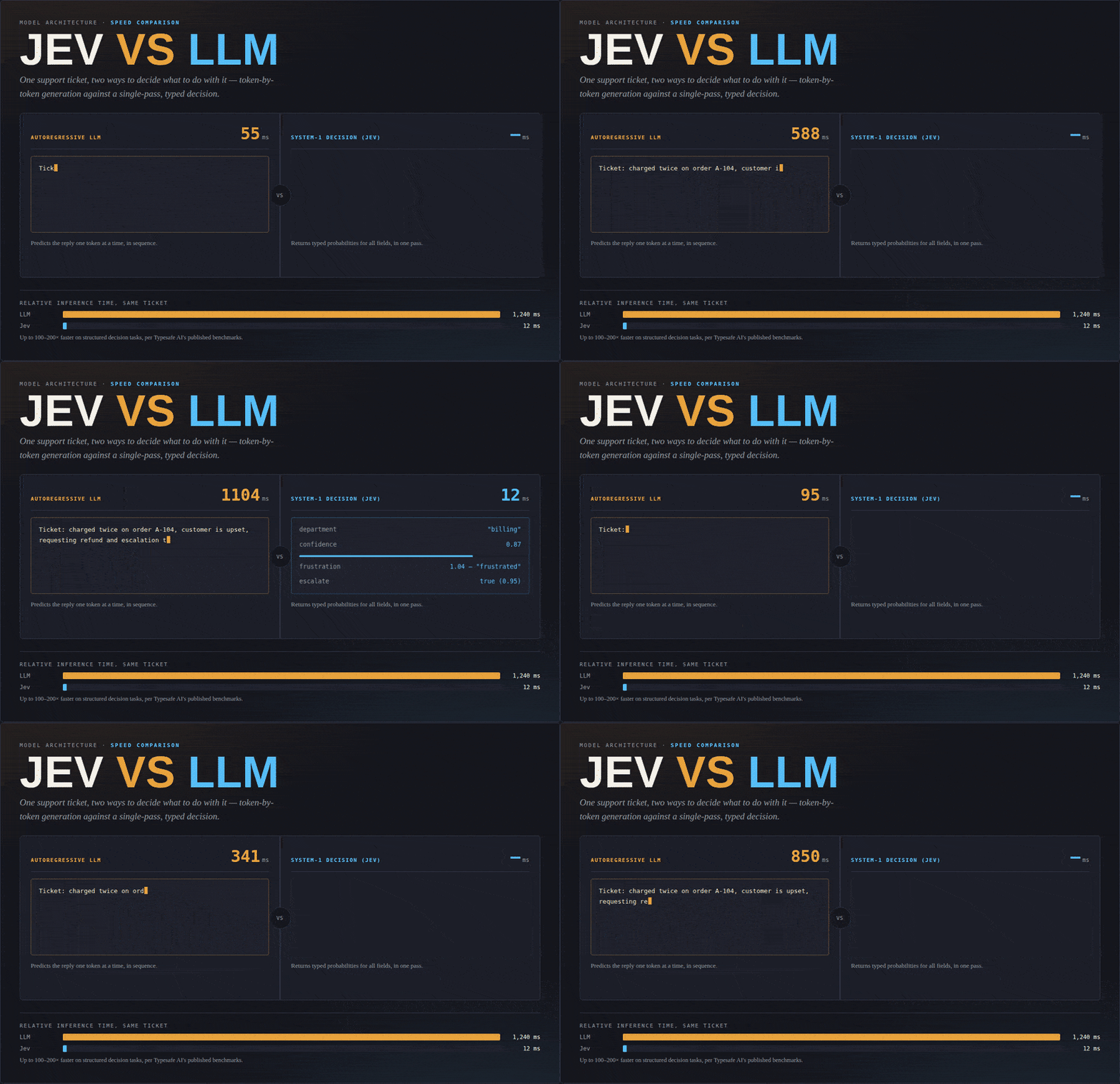
TypeSafe reports end-to-end latency of roughly 70–500 milliseconds and pricing of $0.042 per million input tokens, with output currently described as too inexpensive to meter. The company’s published workflow results claim gains as high as 193.6 times faster and 444.6 times cheaper than comparison workflows using conventional LLMs.
Those are company-reported results, and they should not be treated as universal guarantees. But the reason for the performance difference is technically plausible.
Generative LLMs are autoregressive. They produce one token, feed it back into the model, generate the next token, and continue until the response is complete. Longer answers require more sequential work.
Jev does not write an answer. It produces probabilities over a predefined answer space. TypeSafe says these outputs are sampled in parallel. When the desired result is only billing, high risk or 0.87, generating explanatory prose is unnecessary computation.
An LLM has an enormous output space: it can respond with almost any sequence of words. Jev chooses only among the types and options defined by the developer.
Constrained output reduces freedom, but that reduction is precisely the advantage. The software already knows every possible shape the response can take.
Chat models are commonly optimized to produce responses people find helpful and natural. TypeSafe says Jev is trained using a method it calls Reinforcement Learning for Calibrated Decisions (RLCD).
The goal is not to make the answer sound confident. It is to make the reported probability meaningful. Across many predictions, events given an 80% probability should ideally be correct approximately 80% of the time.
That property is called calibration, and it matters enormously in automation. Software can use it to create explicit rules:
if confidence >= 0.90:
    process_automatically()
elif confidence >= 0.65:
    ask_for_confirmation()
else:
    send_to_human_review()
The thresholds would need to be tested for the specific product and adjusted according to risk. A wrong recommendation is not equivalent to a wrong bank transfer.

Jev can receive multiple questions about the same state and evaluate them in parallel. A support platform could ask about intent, urgency, sentiment, churn risk and escalation need in one call.
This “speculative fan-out” approach is especially interesting for real-time software: the application can request every judgment it may need and later use only the relevant results.

TypeSafe says Jev “can’t hallucinate.” That statement is defensible in one narrow sense but misleading without context.
Because Jev does not generate unrestricted text and can only return predefined types, it cannot invent a nonexistent category, malformed tool name or unexpected sentence. If the allowed values are billing, technical and sales, the model cannot return legal department on the third floor.
That eliminates schema hallucination and free-form output drift.
It does not eliminate incorrect decisions.
Jev can still classify a billing issue as technical, underestimate risk or assign high confidence to an answer that turns out to be wrong. A validly typed mistake is still a mistake.
The accurate interpretation is:
Jev guarantees the shape of an answer, not the truth of that answer.
This is why confidence thresholds, representative evaluation data, monitoring and fallback paths remain essential.
Jev fits situations with four characteristics:
The input contains unstructured or semi-structured information.
The required answer can be defined in advance.
The decision occurs frequently enough for latency or cost to matter.
The application has a clear action for low-confidence results.
Classify the customer’s intent, urgency, frustration and likely next action. High-confidence cases can be routed automatically; ambiguous cases can go to an employee.
Inspect an AI agent’s state or execution trace and decide whether it should continue, retry, change tools, escalate or stop. A decision model can also flag suspicious tool calls, prompt injection or behavior that violates policy.
This may become one of Jev’s strongest roles: not replacing the main LLM, but acting as a fast control layer around it.
Estimate whether a request needs an expensive reasoning model, a fast lightweight model or no generative model at all. Saving even a small amount on each decision can matter at very high volume.
Classify invoices, resumes, insurance documents or incoming email; detect missing information; assign categories; score urgency; and route exceptions for review.
Score whether a retrieved passage is relevant, whether the evidence supports a statement or whether another retrieval step is required. Jev cannot compose the final answer, but it can help control the pipeline that produces it.
Estimate whether an event matches a defined risk condition and use the score as one signal in a larger rules engine. For consequential decisions, it should support—not replace—domain-specific models, deterministic checks and human review.
During a voice conversation, several decisions must happen before a user notices delay: intent detection, interruption handling, tool routing, escalation and safety checks. A model returning structured decisions in hundreds of milliseconds is potentially valuable here.
Jev is the wrong tool when the product needs:
Natural conversation or an explanation written for a person
Creative content, summaries or code generation
Open-ended exploration where the answer space is unknown
Multi-step planning or deep reasoning
A final decision whose correctness must be guaranteed
High-stakes automation without independent validation and escalation
It also should not replace ordinary code when deterministic logic can solve the problem. If the rule is “reject an invoice when its total is negative,” an if statement is cheaper, faster and perfectly explainable.
Use Jev for fuzzy judgments that are difficult to express as rules—not for conditions your software already knows how to calculate.
The most useful architecture may combine both model types:
User or system event
        ↓
Jev: classify, score and route
        ↓
Application code: apply rules and choose tools
        ↓
LLM: reason or produce a human-facing response
        ↓
Jev: evaluate risk, policy compliance or escalation need
The LLM handles language and open-ended reasoning. Jev handles narrow decisions before, during and after the generative step. Traditional code remains responsible for business rules, authorization and irreversible actions.
This separation can make an agentic system easier to observe and test. Instead of hiding every choice inside one enormous prompt, developers can inspect individual decisions, their probability distributions and the code that combines them.
Not yet.
TypeSafe’s published workflow evaluations cover security incidents, agent-trace observability, invoice processing and customer service. The company decomposes each workflow into small model judgments plus deterministic code, then compares results with reference labels produced from the average responses of major frontier models.
This is an interesting evaluation of machine-oriented workflows, but it has important limitations:
TypeSafe designed the workflows and evaluation harness.
The reference is model consensus, not independently verified ground truth.
The comparison favors the kind of narrow, structured task Jev was built to perform.
The largest speed and cost gains are acknowledged by TypeSafe as being at the high end of expected real-world improvements.
Jev is in early access, with limited long-term production evidence.
Independent developer reports are encouraging but still anecdotal. TechCrunch reported one safety-classification experiment where Jev was reportedly faster and more accurate than the previously used chat model, and another email-classification test where Gemini was slightly more accurate but 10–20 times more expensive.
The responsible conclusion is not that Jev “beats every LLM.” It is that a specialized decision model can dominate a generative model when the task only requires a structured decision.
Before placing Jev in a production workflow, a team should answer these questions:
Does the task actually fit a closed answer space? If important outcomes are missing, the model will still select from the options supplied. Include other, unknown or an escalation path where appropriate.
Are its probabilities calibrated on our data? Test real examples from the intended domain, language and traffic distribution.
What happens under distribution shift? Product behavior and customer language change over time.
Which mistakes are tolerable? Measure false positives and false negatives separately rather than relying on one accuracy number.
Where should humans intervene? Define thresholds according to the consequence of each action.
What is the fallback if the service is unavailable? A fast model is still an external dependency.
Are the security, privacy, retention and compliance terms suitable? This is especially important for healthcare, finance and personal data.
Does it outperform a simpler baseline? Compare it with rules, a conventional classifier, embeddings and an inexpensive structured-output LLM.
The most important thing about Jev is not its benchmark headline. It is the design question it forces developers to ask:
Does this part of the product need generated language, or does it only need a decision?
During the chatbot era, language became the universal interface to AI. But most actions inside software are not conversations. They are branches in a workflow.
If TypeSafe’s approach works reliably at scale, models like Jev could become a new layer in software architecture: probabilistic functions placed between deterministic code and generative models. They would make thousands of small judgments that are too fuzzy for rules but too narrow to justify a full LLM response.
That would not make LLMs obsolete. It would let us stop using them for jobs they were never optimized to perform.
Jev is still early, its architecture is largely undisclosed, and its strongest performance claims require broader independent validation. But its central idea is compelling: when software needs an answer, the model should speak the language of software—not write a paragraph and hope the program understands it.
Research checked on September 20, 2026. Jev is an early-access product, so pricing, model versions and availability may change.
Was this helpful?
Give it a zap to let me know.
Or share it with someone
New model by Google: Gemini 4 Argon that beat OpenAI Astra, Anthropic Fable 5.1, and Opus 5.5.
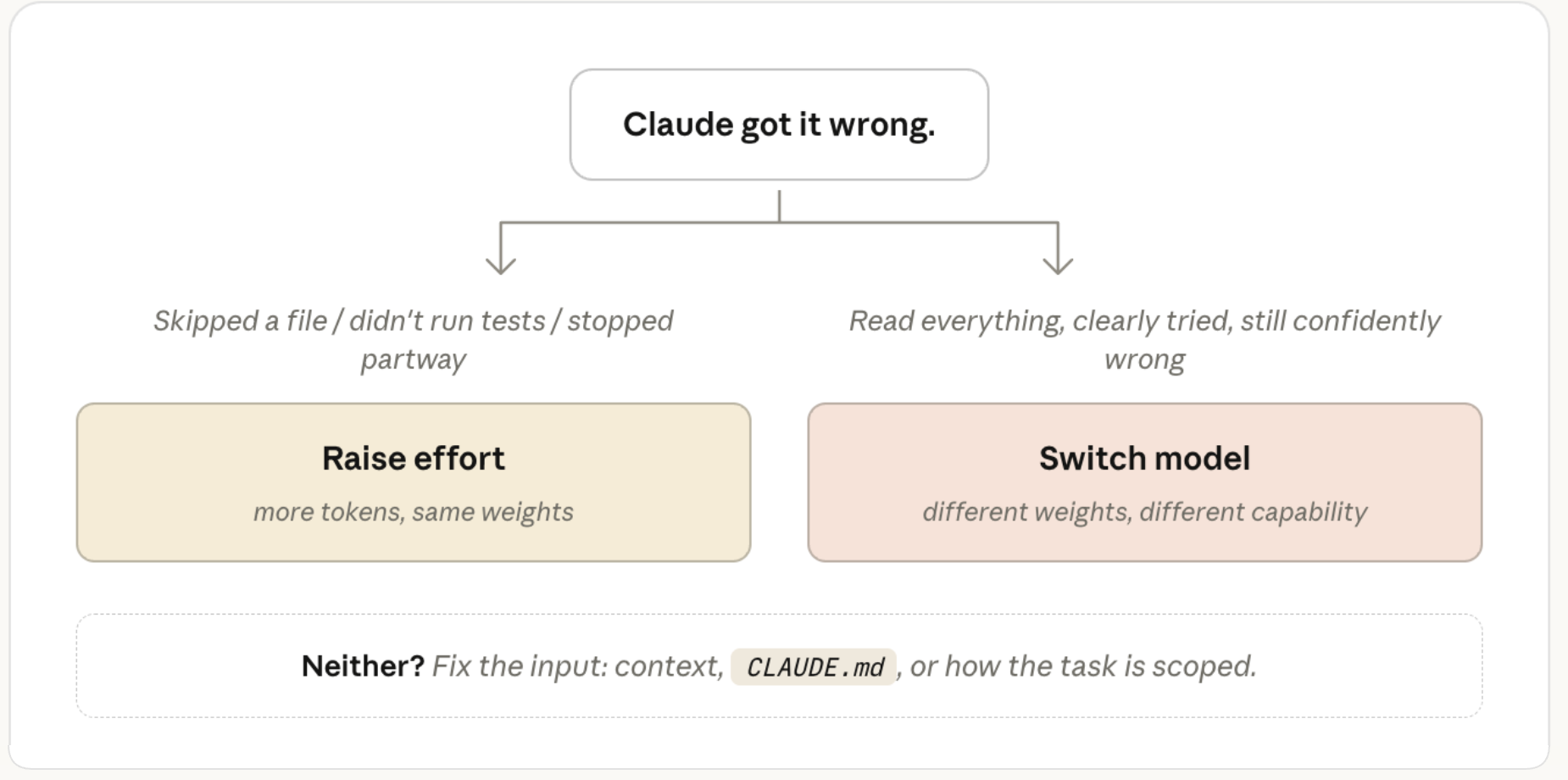
Model selection and effort level solve different problems. The model controls Claude’s underlying capability; the effort level controls how much work Claude does before responding.

Claude Fable 5 and Claude Mythos 5 were temporarily suspended after the US government applied export controls on June 12, requiring Anthropic to restrict access to foreign nationals. Because Anthropic says it had no reliable way to verify nationality in real time, it suspended both models for all users. Those controls were lifted on June 30, and Fable 5 was restored globally starting July 1 across Claude Platform, Claude.ai, Claude Code, and Claude Cowork.